Global Nature Risk - Why we built it, and what it actually measures
Knowing where risk is concentrated is what frees budget to act on it. Global Nature risk provides exactly that, showing which sites carry the highest exposure, what's driving it, and where targeted investment will pay back.
Nature risk screening for any asset, anywhere, at portfolio scale
For years, nature-related risk assessments have followed the same pattern. Commission the data, clean it, model it, and hand over a report that is often months out of date by the time it lands. It's a process that serves individual sites well but isn’t scalable to full portfolios.
Global Nature Risk was built to change that. Not to replace careful site-level work, but to bring the core question, which sites carry the most nature-related risk, and why, within reach of a whole portfolio, without a six-month project per site.
Knowing where risk is concentrated is what frees budget to act on it. A screen provides exactly that, showing which sites carry the highest exposure, what's driving it, and where targeted investment will pay back.
"In financial institutions, the conversation has shifted from disclosure to verification. Investors want evidence that the ecosystems behind an asset still function, and that requires a consistent, credible way to see risk across an entire portfolio." Caitlin Brown, Head of Strategic Innovation, NatureMetrics
‘’This tool doesn't replace deeper assessment, but it tells you which 10% of sites deserve it, so the other 90% don't consume budget that should go where the risk actually is. Companies were making nature-related decisions on capital allocation, site prioritisation and disclosure without a shared evidence base to anchor them. Global Nature Risk provides a consistent, repeatable way to surface what actually matters, at every site, in the same terms." Amy Sellers, Lead Nature Strategist, NatureMetrics
What is nature risk screening and what does Global Nature Risk actually produce?
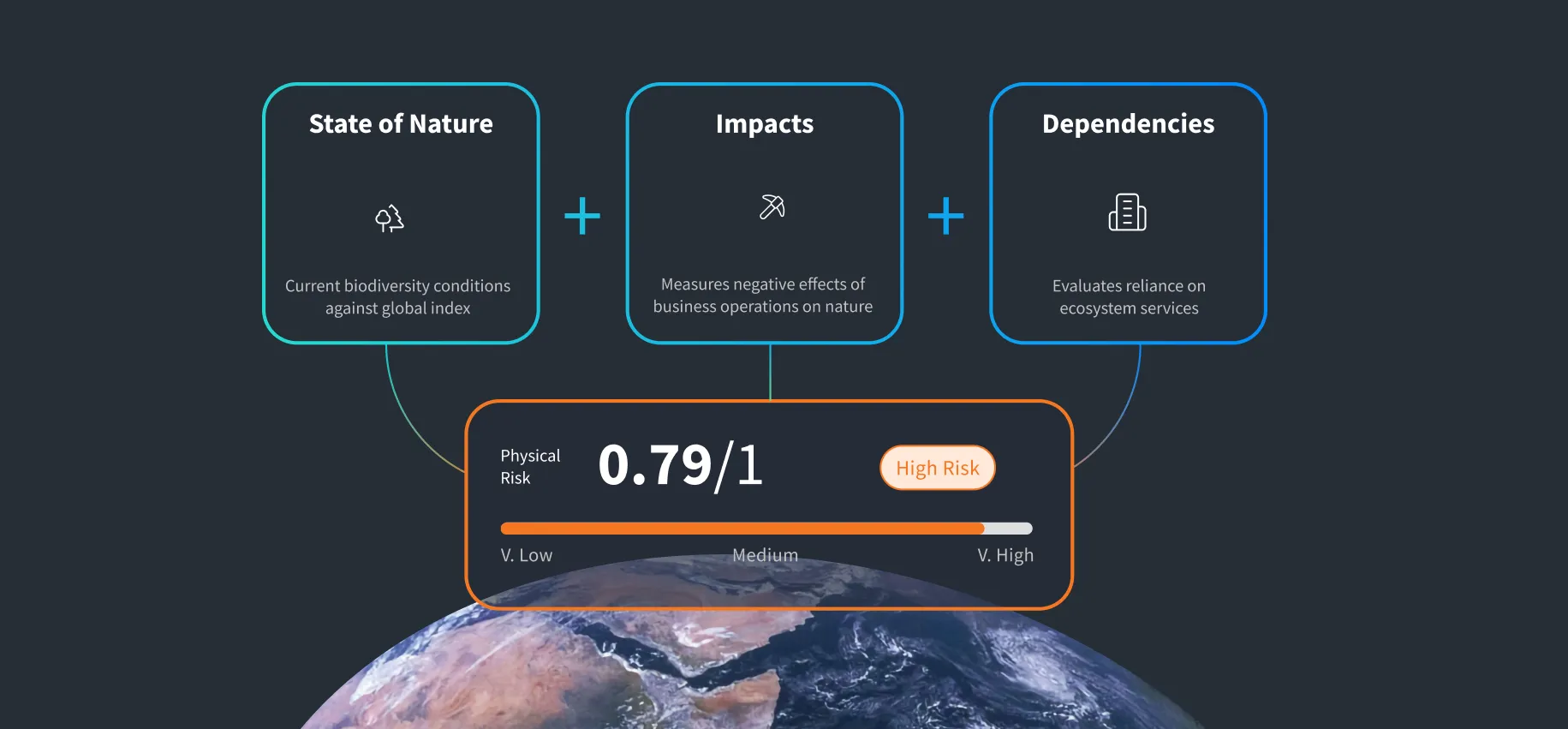
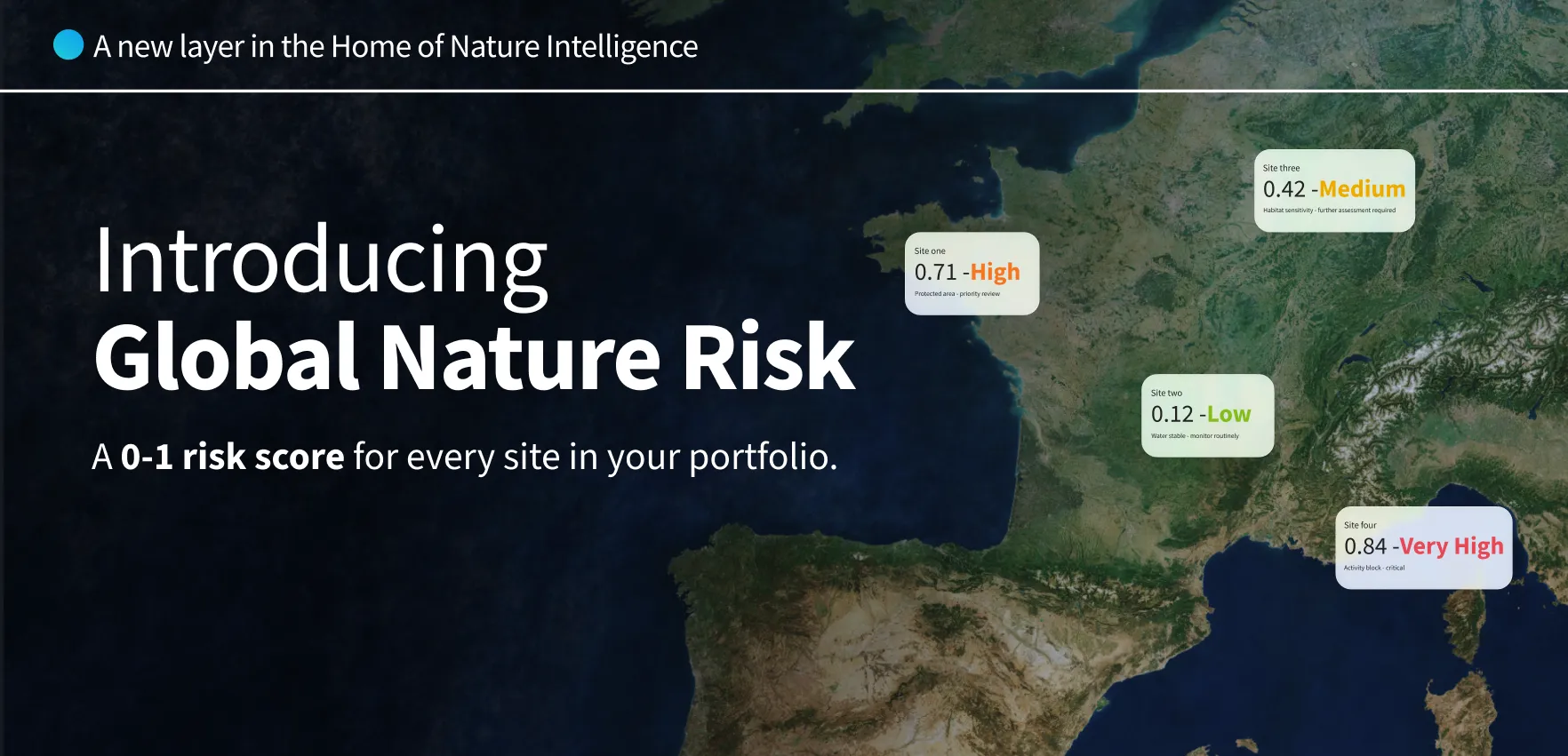
Global Nature Risk is the screening layer of the NatureMetrics Nature Intelligence Platform. Input a site's coordinates and activity code; within weeks, every asset receives a score on a single 0 to 1 scale reflecting its combined nature-related risk.
That score answers both sides of double materiality, a business's impacts on nature and nature's risks to the business, and is aligned with the TNFD (Taskforce on Nature-related Financial Disclosures). It incorporates ecosystem condition, species data powered by millions of eDNA data points, dependency exposure and regulatory context into a single, decision-grade signal.
The output is not a static report. Scores refresh quarterly and are built to sit inside regular business review cycles rather than arrive as one-off deliverables. Every site sits on the same scale, so results roll up across an entire portfolio or break down to a single asset - making it straightforward to prioritise, compare and act.
The problem: organisations don’t know where to look
When organisations begin working on nature risk, the start is almost always the same: they do not know where to look. They have hundreds or thousands of assets across dozens of countries and no consistent way to compare them, and the instinct is to measure where attention already sits, not where the material risk is.
Existing tools fall into two camps. Proximity screening tells you what is near a site, which is presence, not materiality: a mine and a head office in the same place do not carry the same nature risk. A bespoke assessment takes months and a large budget, and dates quickly. Global Nature Risk sits in the gap, rigorous enough for investors and regulators and fast enough to run across a portfolio in weeks.
The methodology: How portfolio-level nature risk is calculated
The shift we care about is from disclosure to action: a screen builds the case for looking harder at high-materiality sites, and surfaces the impact, dependency and risk themes that recur across portfolios, supply chains and business units.
Two questions, one foundation.
Nature risk has two sides: a business’s impact on nature and nature’s risk to the business. The state of nature at a location is the hinge between them. A healthy system absorbs pressure and keeps providing what an asset depends on; a degraded one raises the weight of every impact and weakens every dependency.
Species are the earliest signal.
Species respond to stress first. On one engagement, two sites a client had judged low-risk had already lost significant biodiversity: the habitat still looked healthy from a satellite, but the species told a different story. Our Species Risk Prediction, powered by millions of eDNA data points, flags likely IUCN Red List and invasive species before any fieldwork.
Comparable, and credible.
To drive decisions, results must be comparable and hold up to investors and regulators: we hold nature data to the standard finance already uses, the same rigour as audited accounts.
Why nature risk screening matters now
More than half of global GDP, around US$44 trillion, depends moderately or highly on nature (World Economic Forum, Nature Risk Rising, 2020); the World Bank estimates the collapse of selected ecosystem services could cost up to US$2.7 trillion a year by 2030 (The Economic Case for Nature, 2021); and around US$7 trillion a year still flows into activities that harm nature (UNEP, State of Finance for Nature, 2023).
Reporting requirements are following the economics. Mandatory rules are widening, from the EU’s Corporate Sustainability Reporting Directive (CSRD) and Deforestation Regulation (EUDR) to the International Sustainability Standards Board (ISSB) baseline, alongside voluntary frameworks such as the TNFD, CDP and the Global Reporting Initiative (GRI). The question is no longer whether to assess nature risk but how, at portfolio scale, to stand behind it.
For NatureMetrics, this is also about a just transition. We built Global Nature Risk to be scalable and low barrier to entry, so the whole economy can move, not just the few who can budget for a bespoke study. Cost should not decide who acts: SMEs and large multinationals alike need a way in. The shift that matters is seeing nature not as a compliance cost centre but as a strategic asset to protect, manage and secure, which unlocks budgets and moves capital away from harm.
Finding where risk is not
In 2025 we completed a global portfolio assessment for a major energy company: around 40,000 features across more than 70 countries. Just 11 per cent of the portfolio accounted for the locations where risk was most acute. The other 89 per cent could be deprioritised with confidence, because the method gave a credible basis for doing so.
That is the value of a consistent framework: not only finding where risk is high, but establishing where it is not. Our advice is always the same: start with your highest-exposure geographies, not your highest-profile ones, then go deeper.
How different sectors use it
Mining and extractives: rank concessions and assets by nature risk before exploration or acquisition spend, see which sites need deeper assessment, and target mitigation where it counts.
Energy and renewables: compare sites across a global pipeline on one scale, and direct due diligence and monitoring to the locations carrying the most risk.
Agriculture and food: find where sourcing landscapes are most exposed through their dependence on water, soil and pollination, before it shows up in yield.
Financial institutions: screen a loan book, fund or acquisition target for nature exposure before capital is committed, compare assets on a standardised basis, and bring nature risk alongside the risks already priced. This group has most often lacked a consistent way to see it, and a comparable, portfolio-wide score makes the biggest difference here.
Who we are, and where Global Nature Risk sits
NatureMetrics is a nature intelligence company. We generate biodiversity data using environmental DNA (eDNA), bioacoustics, Earth Observation and data science, and bring it together in a single Nature Intelligence Platform used by 600+ organisations across more than 126+ countries.
Global Nature Risk is the top of that stack: the screen that shows where risk and impact are concentrated, so you know where to point the deeper work beneath it, from eDNA surveys to condition monitoring and advisory, which feeds back into the same view.
What comes next
There is more to build, and it will keep evolving as we learn from the organisations using it. But the direction of travel is clear: nature risk will be priced the way credit risk is. It is already on the balance sheet, and the question is whether you can find and act on it before the financial consequence hit.
Global Nature Risk is available now. To talk through what a portfolio assessment could look like for your organisation, get in touch.
Hear from the team that built it.
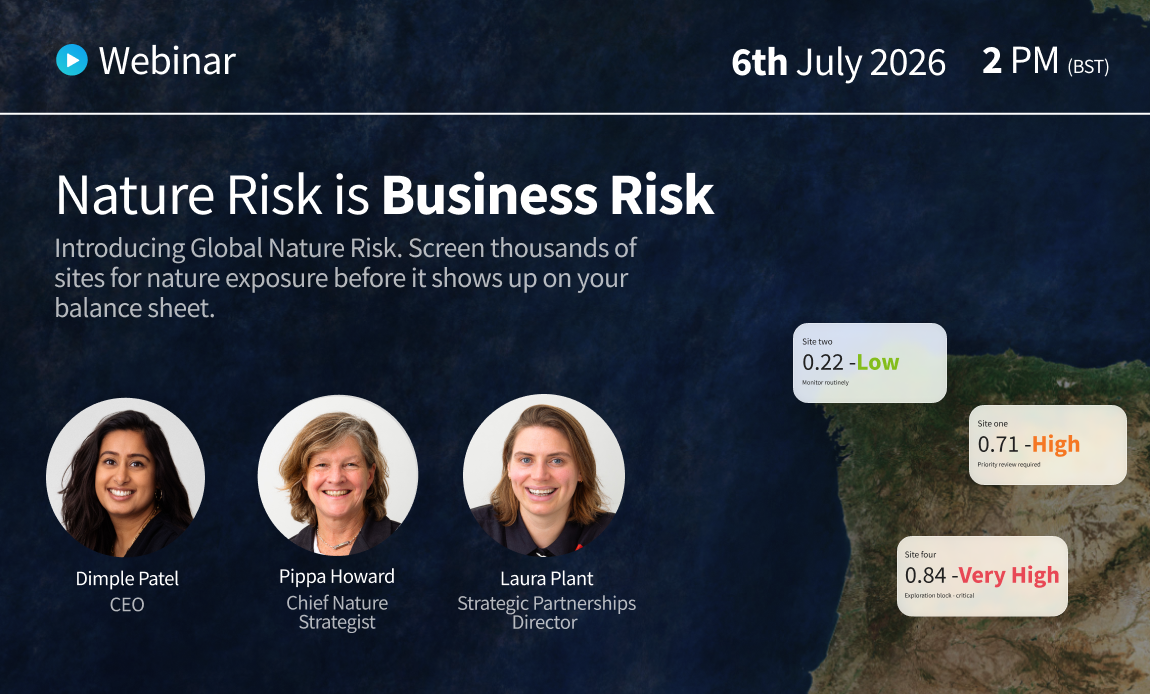
On 6 July, CEO Dimple Patel, Chief Nature Strategist Pippa Howard and Strategic Partnerships Director Laura Plant talk honestly about what nature risk means for your balance sheet and what Global Nature Risk was built to do about it.
NatureMetrics has launched its new Global Nature Risk tool. This risk screening solution is designed to help businesses understand, prioritise and act on nature-related risk across entire portfolios by providing businesses with a dynamic and quarterly updated view of nature-related risk across their sites.
By clicking “Accept”, you agree to the storing of cookies on your device to enhance site navigation, analyze site usage, and assist in our marketing efforts. View our Privacy Policy for more information.





.jpg)

.jpg)
.png)