Detect more species in less time with eDNA

Environmental DNA is reshaping biodiversity monitoring, giving ecologists richer data, companies clearer compliance pathways, and nature a stronger voice in every decision.

What is eDNA

All living things leave traces of their DNA in the environment,  shed through skin cells, mucus, waste, and tissue. This genetic material, suspended in water, soil, or air, is what we call environmental DNA (eDNA).

By collecting and sequencing these traces, NatureMetrics tells you exactly which species have been present - without capturing or disturbing a single animal. A litre of river water reveals the full ecosystem of fish, amphibians, and mammals. A handful of soil maps the fungi, bacteria and invertebrates beneath your feet.

This gives decision-makers the most comprehensive, standardised, and actionable biodiversity data available, across any habitat, at any scale.

How we got here

2014

purple fish swimming through hexagon

NatureMetrics was founded by a group of scientists who were determined to connect environmental managers with the data they need to monitor biodiversity.

Following initial support from the NERC Follow-On Fund in 2015, we raised £250k from Iceni Seedcorn Fund and a consortium of business angels to set up our first labs in early 2016. We opened our labs in April 2016 (just in time for newt season!) and have been delivering our commercial services ever since.

2015-2016

2016 - 2017

Our focus in 2016-2017 was on optimizing and validating our core services of eDNA metabarcoding for fish and other vertebrates, including the design of our sampling kits and refinement of laboratory and bioinformatics workflows. Early collaborations with Dr Micaela Hellstrom at Aquabiota (Sweden) and Dr Bernd Hänfling (University of Hull) were key to this stage of our journey, along with early pilot projects with ERM, Natural England and Jacobs.

2017-2018 saw steady and consistent growth of our team and our commercial offerings. With our core services validated, we began working on projects that were larger, more complex, and further afield, including a major baseline study of the Northern Peruvian Amazon with WWF Peru. Our Innovate UK-funded project, NemaCode, enabled the development of our soil and sediment analysis services.

2017 - 2018

2019

2019 saw the start of a major expansion following a £2.5M investment led by Green Angels Syndicate with TriplePoint. During this year we also worked on our first major EIA projects with the energy, mining and infrastructure sectors. This included freshwater, marine and terrestrial projects in the UK, Latin America and Africa.

In early 2020, Katie Critchlow joined us as CEO to steer us through this next phase of growth and consolidate our position as global leaders in this industry. Despite the challenges of 2020, we have continued to grow both in terms of the scale of our projects, the development of our products and services, and the size and expertise of our team, which has doubled in size over the course of the year. In particular, we have significantly expanded our business development and operations teams to reflect the now-global nature of our client base.

A GCRF-funded project in Mozambique helped us to further develop our logistical and technical capabilities while establishing a fantastic network of collaborators in Southern Africa. Meanwhile, we were selected for the HS2 accelerator, which has supported development of our digital strategy and facilitated a valuable large-scale demonstration project on woodland soil biodiversity. We have partnered with various international conservation NGOs to develop ambitious projects for global biodiversity conservation and to validate our solutions for business and biodiversity.

whale swimming through hexagon

2020

2021

As NatureMetrics enters a new growth phase in 2021, the new brand identity is launched to represent our global connections and cutting-edge technology.

NatureMetrics firmly establishes itself as a world leader in delivering nature data and intelligence, using cutting-edge technology to generate biodiversity data at scale using environmental DNA. NatureMetrics attends COP15 in Montreal and launches the world’s first nature performance monitoring service, powered by eDNA.

2022

2023

The Nature Intelligence platform is launched. The platform enables comprehensive nature impact monitoring and reporting, powered by eDNA.

Nature Strategy service is launched, headed by Pippa Howard. The service will support companies to advance their nature strategies and  meet incoming nature reporting requires, such as TNFD and SBTN.

sea turtle swimming through hexagon

2023

eDNA sampling is easier and safer than conventional monitoring

Conventional biodiversity surveys, like electrofishing and visual ID, require specialist licences, protected species handling, and methods that carry real ecological and human risk.

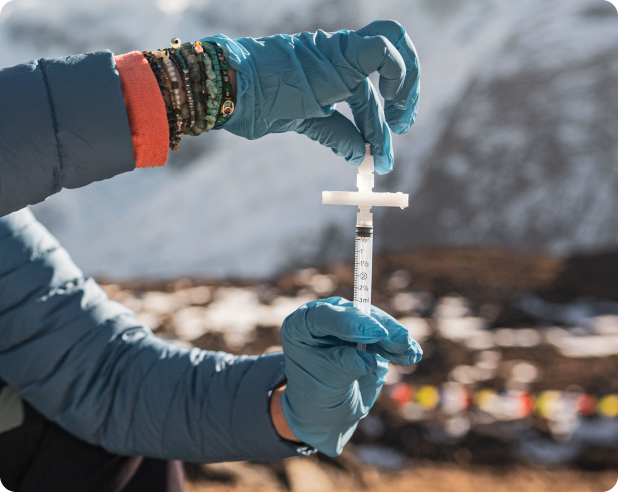
eDNA replaces all of that with simple kits to filter water, sample soil, pump air, or swab surfaces. Collection takes minutes, needs no specialist training, and causes no disturbance.

eDNA sampling can be integrating into existing operations and our standardised and simple protocols eliminate observer-skill variability across sites, teams, and years.

quarry from overhead with a blue hexagon overlaid

eDNA sampling has a higher data return vs sampling effort

Conventional ecological surveys require significant fieldwork time, specialist expertise, and carry risks to both surveyors and species. eDNA sampling dramatically reduces on-the-ground effort while capturing far richer biodiversity data, detecting rare, cryptic, and hard-to-observe species that traditional methods routinely miss.

Use eDNA across the mitigation hierarchy and project lifecycles

From early-stage baseline assessments to long-term post-construction monitoring, eDNA provides consistent, comparable data at every phase of your project — helping you demonstrate credible progress and meet evolving reporting obligations.

quarry from overhead with a blue hexagon overlaid

Simplify your nature impact reporting